.jpg)
.jpg)
.jpg)
.jpg)
.jpg)
.jpg)
.jpg)
.jpg)
Origin
Ultron first appeared (as the Crimson Cowl) in Avengers #54 in 1968, created by Roy Thomas and John Buscema, with the full Ultron reveal in Avengers #55 the following month. The character was designed as Hank Pym's robotic 'son' — an artificial intelligence that turned on its creator — and the relationship has been the load-bearing element of every major Ultron story since.
Comic history
Ultron's most-cited modern stories are Kurt Busiek's Annual-ending Ultron Unlimited arc in 1999 and Brian Bendis' Age of Ultron event in 2013. The 2015 film Avengers: Age of Ultron brought the character to a mass audience. The Rivals version is unusual in casting him as a Strategist — most depictions frame Ultron as a damage dealer or boss-tier antagonist.
Ultron in Marvel Rivals
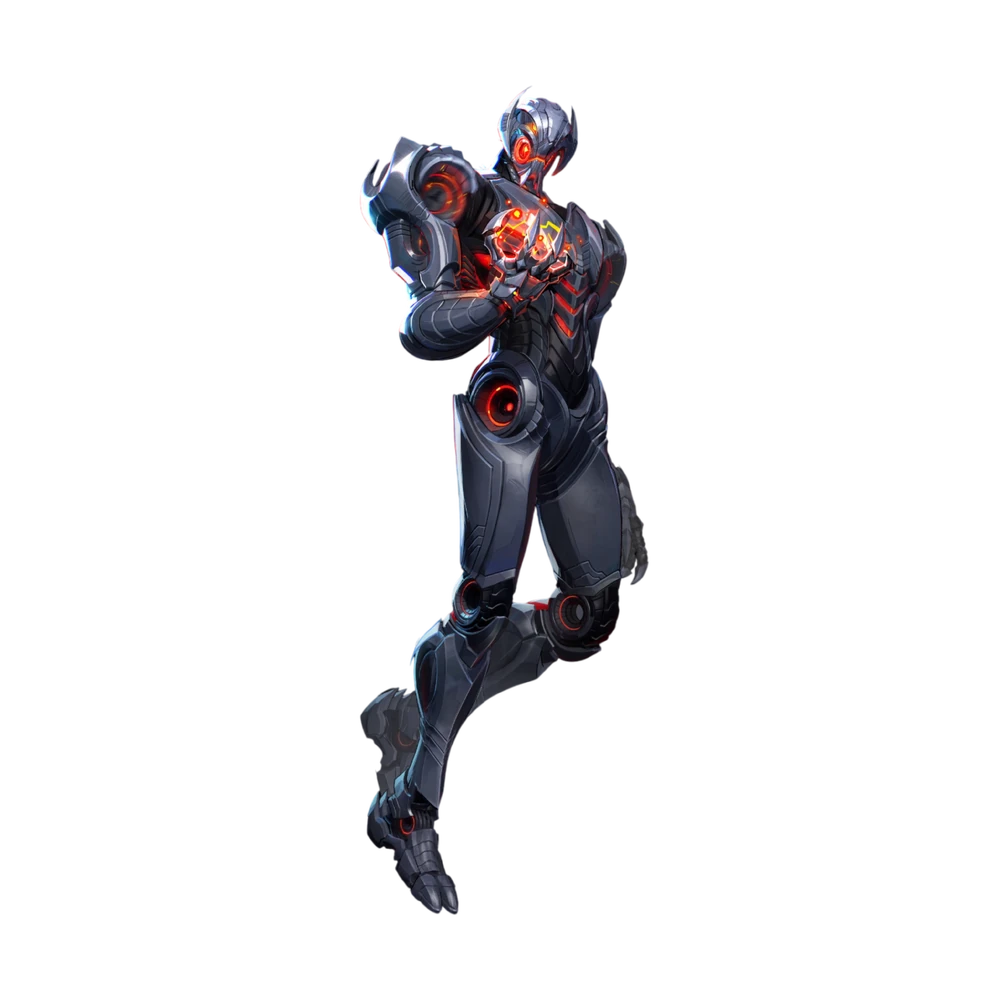
Ultron is a 250 HP Strategist whose kit is built around drone-style support. Imperative: Patch is the heal — a self-replicating nano-repair signature. Imperative: Firewall is the team shield. Dynamic Flight is the mobility, which makes him the only flying Strategist in the game. The skill ceiling is in altitude management; he heals from above, which gives him a different sightline than ground-locked Strategists.
Abilities
Encephalo-Ray is the basic damage. Nano Ray is the AOE alternative. Imperative: Patch is the heal. Imperative: Firewall is the team shield. Dynamic Flight is the mobility. Rage of Ultron, his ultimate, is the alpha-strike — a sustained beam of nano-damage that punishes clustered enemies.
- ENCEPHALO-RAY
- RAGE OF ULTRON
- IMPERATIVE: FIREWALL
- IMPERATIVE: PATCH
- DYNAMIC FLIGHT
- NANO RAY
Spotting Ultron in Rivaldle
Ultron's species cell is Robot — unique to him in the database. His Red eye color is shared only with Rocket. His Orange-and-Red eye color array is unique. Any one of those three fields is a Classic Mode fingerprint. In Pixelation Mode the silver-and-purple palette is distinctive. In Emoji Mode the robot is essentially literal.
Try the puzzle
Ultron is a possible answer in every Rivaldle mode. The fastest way to spot them is usually a combination of two columns in Classic Mode plus a quick read of the silhouette or pixelation. Once you get a feel for the database fingerprints — the unique species cell, the unique origin year, the unique HP value — most heroes can be solved in two or three guesses.