.jpg)
.jpg)
.jpg)
.jpg)
.jpg)
.jpg)
.jpg)
.jpg)

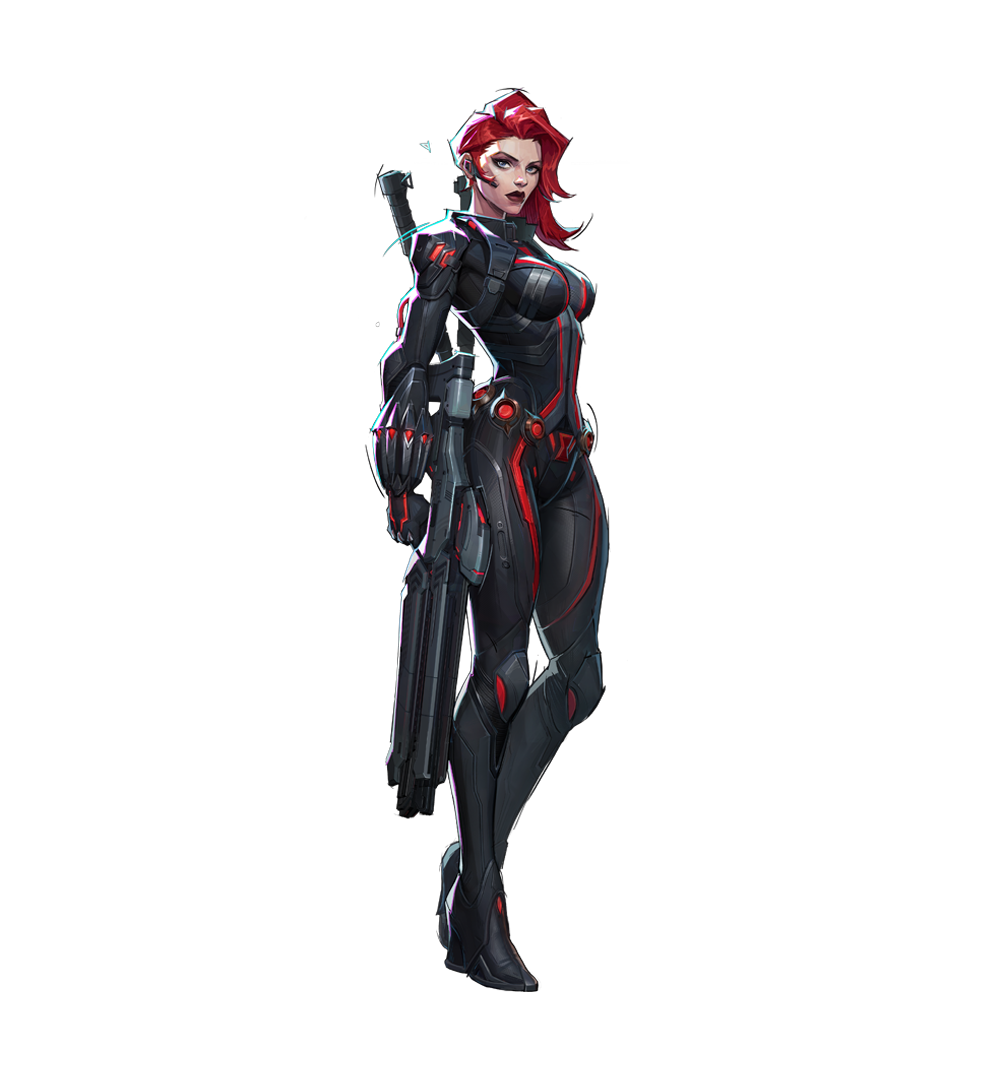
Origin
Natasha Romanoff first appeared in Tales of Suspense #52 in April 1964, written by Stan Lee and drawn by Don Heck. She started as an Iron Man antagonist and a Soviet spy, defected over the next several years of stories, and by the late 1960s was an established member of the Avengers.
Comic history
Most of Black Widow's defining work is in team books — she is one of the longest-running Avengers, a frequent Champions and Defenders member, and the SHIELD-era Marvel Universe's go-to spy operative. The 2016 Mark Waid and Chris Samnee series is the best modern solo material. The Rivals version is built primarily on the Scarlett Johansson film design, with a darker tactical-suit color treatment.
Black Widow in Marvel Rivals
Black Widow is a 250 HP Duelist with the longest-range hitscan in the game via her Red Room Rifle. The kit is built around poke and pressure rather than burst — she does sustained damage from the back line and threatens to clean up low-HP targets that her Vanguards have softened. She is the Duelist most rewarded by patient play; aggressive Black Widows die to dives.
Abilities
Widow's Bite Baton is her melee. Red Room Rifle is the long-range marksman tool. Edge Dancer is the mobility ability. Electro-Plasma Explosion, the ultimate, is a thrown grenade that bounces and detonates with high splash damage.
- WIDOW'S BITE BATON
- RED ROOM RIFLE
- ELECTRO-PLASMA EXPLOSION
- FLEET FOOT
- EDGE DANCER
- STRAIGHT SHOOTER
Spotting Black Widow in Rivaldle
Black Widow's silhouette is one of the more generic in the roster — slim humanoid, ponytail, no large weapon. The hair is the giveaway in Pixelation Mode, where her red ponytail against a black bodysuit is one of the most distinctive color blocks in the game. In Classic Mode her red hair is the strongest narrowing field — she is one of three heroes with red hair, and the other two (Phoenix, Mister Fantastic) have very different roles.
Try the puzzle
Black Widow is a possible answer in every Rivaldle mode. The fastest way to spot them is usually a combination of two columns in Classic Mode plus a quick read of the silhouette or pixelation. Once you get a feel for the database fingerprints — the unique species cell, the unique origin year, the unique HP value — most heroes can be solved in two or three guesses.